Is Traditional Education Enough for Real Life? Rethinking Skills, Success, and Self-Worth
For decades, traditional education has been seen as the safest path to success. Good marks lead to good colleges, good colleges lead to degrees, and degrees are expected to guarantee stable careers. Yet, for millions of young people today—especially in India—this promise feels increasingly incomplete. Despite years of study, many graduates step into the real world feeling underprepared, uncertain, and disconnected from the demands of modern work life.
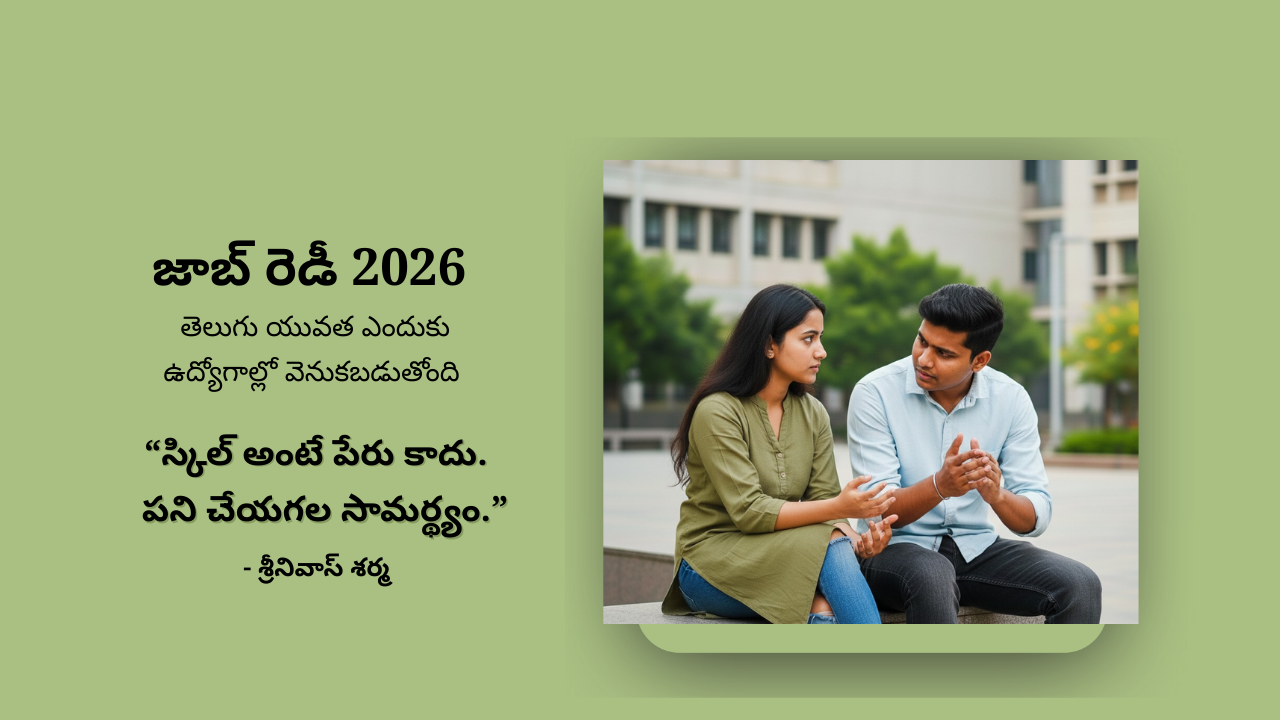
This growing gap between education and employability is at the heart of Srinivas Sharma’s thought-provoking Telugu book, “స్కిల్ అంటే పేరు కాదు. పని చేయగల సామర్థ్యం”. The title itself delivers a powerful message: a skill is not a label or a certificate—it is the ability to actually do the work. Through this lens, the book challenges us to ask a difficult but necessary question: Does traditional education truly prepare individuals for real-world challenges?
The Comfort of Classrooms vs. the Complexity of Reality
Classrooms are structured, predictable, and guided by syllabi. Real life is not. The workplace demands problem-solving, communication, adaptability, emotional intelligence, and the confidence to act under uncertainty. Many students realize too late that while they memorized concepts and cleared exams, they were rarely trained to apply knowledge in real situations.
This is not a failure of effort or intelligence. It is a system that has long prioritized marks over mindset and theory over practice. Students are taught what to think, but not always how to think, decide, and execute. When they enter interviews or workplaces, the shock is not a lack of knowledge—it is a lack of readiness.
When Degrees Don’t Translate into Confidence
One of the most painful consequences of this gap is the silent erosion of confidence. Graduates begin to question their self-worth: If I studied for so many years, why do I still feel inadequate? Srinivas Sharma’s book addresses this emotional reality with honesty and empathy. It makes one thing clear—the problem is not the individual; it is the misunderstanding of what skills truly mean.
A degree may open a door, but skills decide whether you can walk through it. Employers today look for people who can communicate clearly, learn quickly, collaborate effectively, and deliver results. These are abilities built through practice, exposure, and self-awareness—not just textbooks.
Redefining Skills for the Modern World
“స్కిల్ అంటే పేరు కాదు. పని చేయగల సామర్థ్యం” encourages readers to redefine success. Skills are not buzzwords on a resume; they are lived experiences. Whether it is technical ability, problem-solving, or leadership, a skill proves itself only when applied.
The book gently pushes Telugu youth to shift their focus—from chasing certificates to building competence, from fearing failure to learning through action. It emphasizes that employability is not about being perfect, but about being prepared to learn, adapt, and contribute.
Education as a Foundation, Not a Destination
Traditional education still matters. It builds discipline, exposure, and foundational knowledge. But it should be seen as a starting point, not the final destination. Real growth begins when individuals take ownership of their learning—through practical projects, real-world experiences, mentorship, and continuous self-improvement.
Srinivas Sharma’s work resonates deeply with students, job seekers, and even parents because it offers clarity without blame. It does not reject education; it completes it by aligning learning with reality.
Finding Direction in an Uncertain World
For Telugu readers searching for confidence and direction, this book serves as both a mirror and a guide. It reflects the struggles many quietly carry and provides a mindset shift that empowers action. In a world where careers are evolving rapidly, the ability to work, learn, and adapt is the true currency of success.
Ultimately, the question is not whether education is useless—but whether we are ready to evolve our understanding of it. When education is combined with real skills, self-belief, and purpose, it becomes a powerful force for transformation.
Because in the end, it is not the name of the skill that matters —
it is the ability to actually use it.